
Following a competitive call for ideas, 10 promising innovators from the EU and LAC were invited to receive support services under SPIDER. On 11 December, one of these innovative proposals stood out at a final demo-day held with the SPIDER Community.
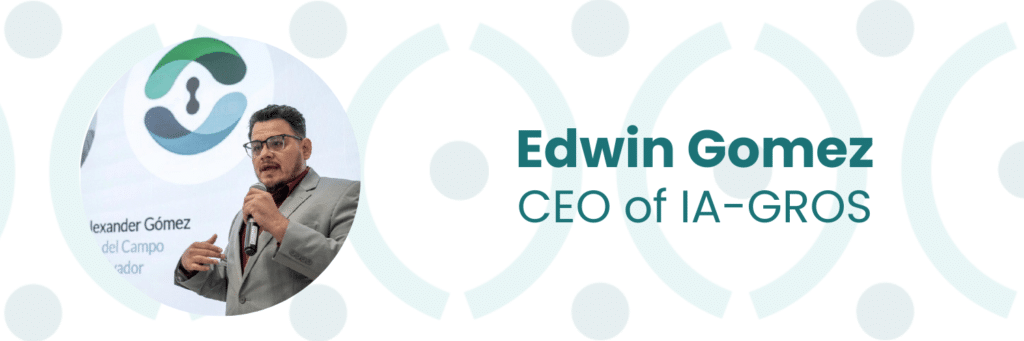
We spoke with Edwin Gómez, CEO of IA-GROS, about his journey, from his unusual background in theology to the flood that led him to start IA-GROS to help local farmers and make agriculture a viable and sustainable option for future generations. The conversation also touched on El Salvador’s potential to become an established hub for agrotechnology and how projects such as SPIDER can be key assets in achieving this goal.
Can you tell us about your academic and professional background?
I am from San Miguel, El Salvador, the dry heart of the Mesoamerican corridor and the most vulnerable region in the world. I have a bachelor’s degree in theology, another in Agribusiness, and a master’s degree in Geopolitics, Global Governance, and Public Innovation.
For the past 14 years, I have worked in the agricultural sector in Central America, where I have experienced first-hand the vicissitudes and problems faced by farmers. It was from specific research activities carried out for a multilateral organisation that I realised that we needed more than simply to generate a report or a perspective: we had to create solutions that addressed these structural problems.
How did this adventure with IA-GROS begin? What motivation or trigger led you to launch the project and become a founder?
It was in 2018, after an extreme weather event. I saw how almost 80% of my suppliers, who were smallholder farmers, lost everything due to flooding. And that’s how I started working to leverage this new industrial revolution of AI to develop solutions for them.
This is technological revolution differs from past ones, in which there was always an inclusion gap, because users did not have the purchasing power to acquire the technologies or the knowledge to use them to their advantage. But AI allows people who are not specialists to benefit from its use. It was through a chatbot that we turned a complex technology into one that was digestible for people who cannot read or write, allowing them to make decisions based on real-time data.
Can you tell us about your startup’s mission and the problem you are trying to solve?
In the Central American Dry Corridor, a farmer can earn, on average, up to $80 per month. This economic reality has caused a break in the generational handover: the younger generations are no longer interested in pursuing agriculture. Added to this is the impact of climate change, which directly threatens this activity. This results in the perfect scenario for agriculture to begin to disappear.
It was in this context that we understood that there was an opportunity: we could take advantage of this generational shift to create a new productive matrix that is more resilient, fairer and more sustainable.
Today, more than 80% of these producers depend exclusively on rain as their irrigation system. Faced with an increasingly unpredictable climate, it was essential to provide them with advanced technologies, many of which are complex even for specialised technicians. That was the real challenge: making the complex accessible and putting it at the service of the producer.
Our mission is not limited to providing data to improve production. We also seek to highlight and value the ecosystem services that these producers generate: carbon capture, water savings, soil regeneration and biodiversity conservation.
With this objective in mind, we travelled to Spain to work with different actors and develop what we now call PES (Payments for Environmental Services) tokens.
Thanks to this model, producers can benefit directly from the use of data to optimise their production, reduce costs and access the European market, complying with the new regulation that requires the pollination of plots. At the same time, it allows companies and corporations to meet their sustainability targets, relying on those who are actually carrying out the activities on the ground.
How do you imagine the future of the sector? How will IA-GROS contribute to that scenario?
Recognizing services to sustain the ecosystem cannot remain symbolic; this recognition must translate into real payment. Only then will agriculture become more profitable and attractive to new generations.
We live in a highly changing geopolitical and geoeconomic context. In this scenario, a solid alliance between Europe and Latin America is not only desirable but necessary. And we believe that this model can become the key mechanism to strengthen that relationship.
Based on this collaboration, it is possible to create a data interoperability standard between both regions. There are resources of enormous value that are currently underutilised: networks such as RedCLARA, supercomputing infrastructures and technical capabilities that require specific drivers to be activated.
We believe that IA-GROS can be that driver, especially when it comes to natural capital and climate change in the region. If you ask us what our greatest asset is, the answer is clear: networks.
We have built networks in France, Spain, England, Brazil, Colombia, Mexico and Central America. We took this approach because we understood that developing the project was costly and that we did not have the necessary capital to develop complex algorithms or build physical infrastructure on our own. The alternative was clear: strategic alliances.
What is your competition and what is your main competitive advantage?
There are many competitors entering the field of environmental monitoring, but we have a key differentiator: through these strategic alliances, we create a barrier to entry.
We do not create all the solutions ourselves, but rather identify technologies that have already been validated in the market and incorporate those that are truly needed. This allows us to do two things: create that differentiating barrier against the competition and encapsulate tailor-made solutions for the producer.
In addition, we have a key player who, by packaging the technology with us, lowers costs and allows us to offer highly customised and powerful solutions at very affordable prices.
What part of your product was the most difficult to create and why?
The real bottleneck is on the commercial side. Going producer by producer is not scalable, it is expensive and does not generate the systemic impact we are looking for.
When we approach investment funds with a technology at Technological Readiness Level (TRL) 7-8, the reply is usually the same: it is not yet commercially mature enough to invest in. But at the same time, we do not have the financial capacity to deploy it and generate revenue.
That is the critical point. When you present something truly new, there is no benchmark for comparison, and the market needs references to assess the risk. That is where the biggest barrier arises.
To solve this, we opened a £1.8 million funding round in December, which will allow us to strengthen the project. At the same time, we are consolidating a consortium of nine companies from England, France and Spain, with the aim of applying for a £20 million funding. This type of financing allows us to move forward without the immediate pressure of a traditional fund that demands short-term returns, which is key when working with deeptech and limited resources.
The plan is to combine structured financing, grants and strategic players who understand this stage of our project. The scientific and technological barrier has already been overcome. Today, the real challenge is implementation and commercial scalability.
About SPIDER
Looking back, what part of SPIDER’s support was most useful for the development of your startup and why?
It may sound a bit cliché, but restructuring the pitch and putting what I thought belonged in the middle at the beginning was very positive. Now, when we tell our story, it creates much more impact than it used to.
Why is EU-LAC cooperation important for your start-up?
Europe has the technology, knowledge and infrastructure. Latin America contributes with natural capital, talent and territory. The combination of both blocs has the potential to create a highly beneficial model for all, especially in the current global context.
The recent signing of the EU-Mercosur Agreement is clear evidence of this. Although agriculture is at the core of this agreement, it has historically been one of the sectors which have generated the most friction, not because it lacks value, but because of inadequate management.
If properly addressed, this integration can even represent a competitive advantage for European farmers, as long as they can objectively and verifiably demonstrate their environmental and productive impact. This will be key not only for trade, but also for access to climate finance and markets linked to carbon trading and ecosystem services.
Until a few days ago, our proposal had clear relevance for America. However, following the abrupt withdrawal of 66 entities from certain commitments, it is now Europe that continues to meet the most demanding standards. In this scenario, concepts such as Environmental, Social, and Governance (ESG), climate finance, energy transition and Global Gateway converge.
That is where we have decided to place our bets. IA-GROS was created precisely to close gaps, connect and overcome barriers that have hindered the massification of this collaboration between Europe and Latin America, particularly in the agricultural sector.
Our goal is clear: to turn that strategic vision into an operational infrastructure capable of aligning capital, data, regulation and action on the ground.
Have you been able to connect with partners, collaborators or potential customers across Europe and LAC through this initiative? If so, can you give an example?
Yes, with two other participants in the SPIDER supporting activities: an organisation from Guatemala (Expediente Médico en Línea, para movilidad estudiantil y profesional utilizando almacenamiento basado en blockchain) and an organisation from Argentina (Género y Seguridad de la Información en Red, Plataforma de Recomendación y Formación para Ecosistemas PYMEs en América Latina y Europa).
The organisation in Guatemala works with blockchain; we also mentioned to them that perhaps some of what they have could be added to what we already have on our project.
The cybersecurity project in Argentina is quite advanced, and we believe we can integrate it. Because, in the end, all we are collecting is data, and this data becomes what we call agricultural digital identity, something similar to the European digital passport for goods.
Other than that, just by announcing that we had been selected by SPIDER on LinkedIn, three public entities that we had already been in contact with, but with whom our conversations had been incomplete, approached us. The announcement renewed these interactions.
How does being part of an initiative focused on the EU and Latin America influence your vision of interregional innovation ecosystems and future opportunities for your start-up?
Being selected by SPIDER means having competed directly with research centres and scientists before a top-level evaluation panel made up of industry experts who understand, interpret and evaluate complex technologies.
Because of that, we feel that we are now being seen as we should be: not as just another startup, but as an initiative with real capacity to generate technological and scientific impact. That is the true value of this participation.
Finally, what are the next steps for IA-GROS and why should the SPIDER community follow your startup closely?
The first step is to ratify the consortium of nine companies that we already have with IA-GROS. The second step will be to launch a crowdfunding campaign for the investment round. We will have a crowdfunding campaign and a traditional round.
The third is to make Madrid the European interoperability hub. El Salvador will need a lot of help and collaboration to consolidate itself as a regional Agrotech hub, as we firmly believe that international coordination and support for projects such as SPIDER will be key to achieving this.
We’ll need all hands on deck, and we believe that SPIDER will demonstrate that ELLA-Link, the Copernicus satellites and everything we have can be leveraged so that both regions benefit in symbiosis.